
Data-Driven Underwriting & Analytics With MeridianLink Consulting

On-Demand Webinar

The demand for digital experiences, shifting consumer expectations, rising competition from fintechs, and availability of data have changed the lending landscape.  

Learn how your financial institution can harness its data alongside robust analytics solutions to compete in this rapidly evolving environment in our upcoming webinar “Data-Driven Underwriting & Analytics With MeridianLink® Consulting.” We’ll be sharing how MeridianLink® analytics solutions—part of MeridianLink® Consulting—can help you automate underwriting and provide deep analytics for each stage in the lending lifecycle to drive better engagement and portfolio growth. 

Discover

  • Automated & Optimize Underwriting: Explore tools including Customer Score, Member Score, and Decisioning Optimization to streamline your underwriting process. 
  • Montior Portfolio Performance: Evaluate your portfolio performance to ensure it aligns with your strategic goals using transition analytics solutions. 
  • Develop Engaging Marketing Outreach: Learn how MeridianLink® solutions can leverage data to create personalized outreach for better outcomes. 
  • Sharpen Your Lending Strategy: See where lost consumers venture and identify challenges in your lending process to retain more consumers.  
  • Peer Perspectives: Hear from Chevron Federal Credit Union as they share trends they are observing and how they effectively utilize data and analytics solutions in their operations. 

Join us to see how MeridianLink Consulting can help you improve your institution’s performance for lasting success! 
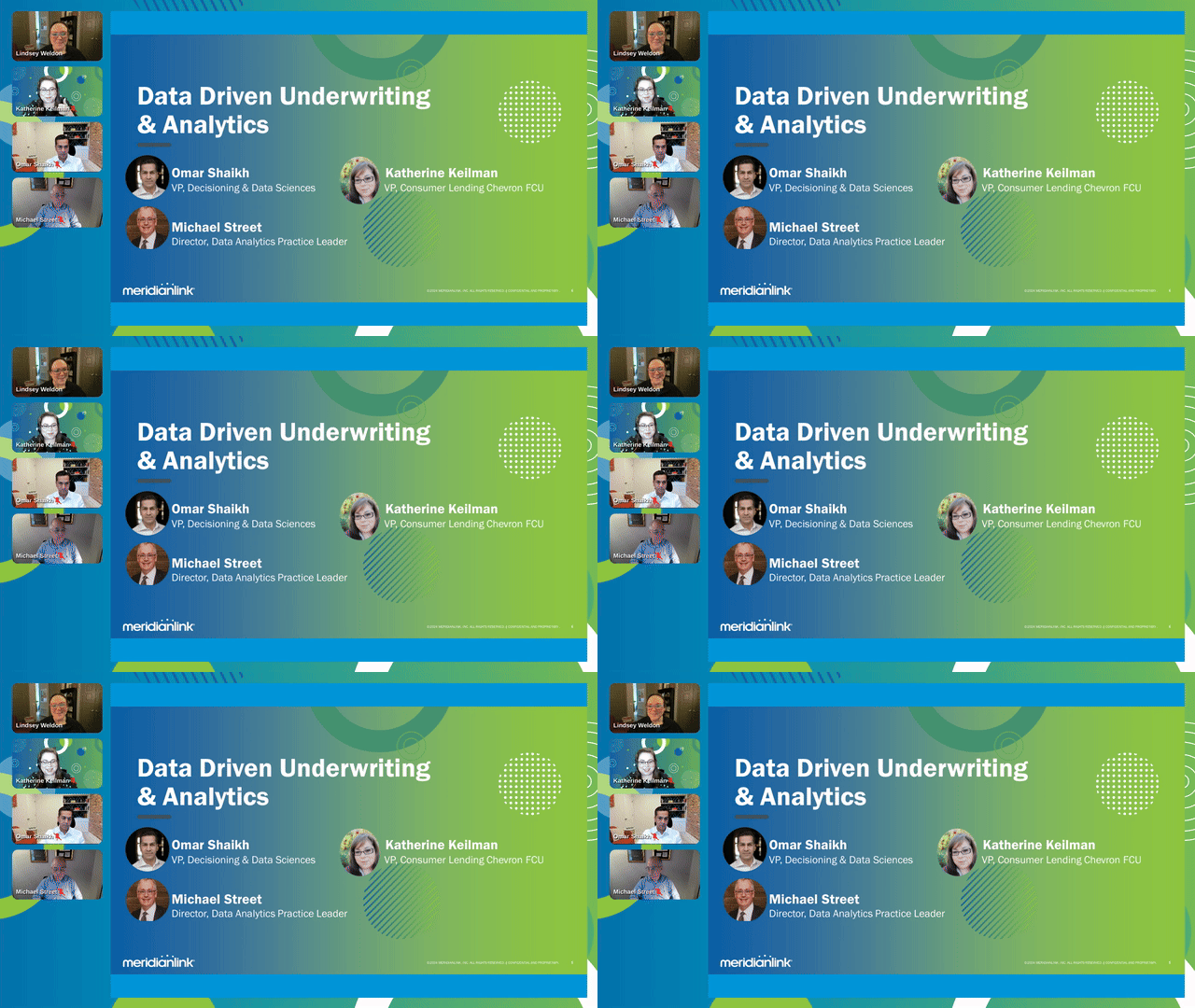
Presented By:

Omar Shaikh,
VP, Decisioning & Data Sciences, MeridianLink

Michael Street,
Director, Data Analytics Practice, MeridianLink

Katherine Keilman,
VP, Consumer Lending, Chevron FCU

Introduction and Housekeeping 

Lindsey Weldon 

00:17 – 02:40 

Thank you, guys, for joining us. We’re going to give everybody a minute to log on. 

I’ll be right back. Alright. 

Thank you, guys, so much for joining us today. We are so excited to have you join our MeridianLink Consulting Analytics team for the topic data driven strategies and risk scoring solutions to transform your underwriting. 

I’m Lindsey Weldon, a member of the Meridian Link product marketing team, and I’d like to introduce our speakers today. From Meridian Link Analytics, we have Omar Shaikh, our VP of Decisioning and Data Sciences. 

And from Valley Strong Credit Union, we have Josh Fuddings, the VP of Consumer Lending. Before we get started, just a few housekeeping notes. 

Today’s session will be recorded. If you object, please disconnect at this time. 

If this topic interests you, we would like and you would like to learn more information, you will have the opportunity to request a meeting with Omar and his team to learn more about your situation and how we can help them at. And we’ve also built in time for your questions today. 

So, on the far right, you’ll see the q and a tab. Please be sure to put your questions in there, and we will go through them in the end. 

And, we will also be sending a recording of this out to you tomorrow for you to share with others. So, with that, I’m handing it off to Omar so he can get started for the day. 

Omar Shaikh 

02:40 – 03:20 

Thank you, Lindsay. I appreciate it. 

First of all, I’m very excited to have Josh with us to talk about a topic with Josh and I have been working for a while. Josh has been using MeridianLink, of course, the LOS and our solutions for a while. 

So, I think his insight, as we talk about what options are available, is critical. It’s helpful for our, our our customers, to hear from their peers as well. 

So, Josh, thank you for joining. I appreciate you taking the time from your day to kind of join us and, talk through these things. 

Josh Fetting 

03:20 – 03:23 

Thanks for having me, Omar. Happy to be here. 

Omar Shaikh 

03:23 – 08:35 

Right. A quick overview of the agenda. 

We’ll talk about who we are, what trends we are seeing in the marketplace, talk about how best to leverage data and analytics and its role in lending and specifically in auto decision. And I think when we talk about auto decisioning, there’s been so much conversation. 

There’s been, of course, we have so much conversation around use of AI and data and analytics. We’ll cover some of those topics. 

Towards the end, we’ll talk about the MeridianLink solutions, which are available to help automate your underwriting. And then, of course, as Lindsay said, we’ll make sure we leave time for, q and a. 

First, a quick introduction of the MeridianLink Analytics practice. We are part of the consulting and strategic services group. 

Our focus is to provide services which help maximize the value, you get out of the LOS that you are using. Our primary focus is automated decisioning, underwriting, and risk scoring. 

Of course, when you book those loans, monitoring that portfolio, those are the key services that we focus on. And the services are agnostic to the decision engine you’re using at MeridianLink. 

MeridianLink has a few decision engines and different folks use different engines. Our services, span across all of those. 

A very important element for us to think about the solutions which we use and how we leverage data and analytics is, important to look at what market we are in operating and what’s the environment we are operating in, what are the macro trends related to macroeconomic trends and just trends in the industry. One of the biggest trends which we’ve been talking about and hearing about in the last few years is the digital shift. 

Of course, the COVID crisis sort of expedited that a little bit. The digital base that sort of gained from that has continued to accelerate. 

And consumers more and more want digital experiences. And digital experiences which are seamless, they want to interact with their financial institution the same way they are able to book a flight online or order Uber or order food and things like that. 

So, what their digital experience. They want to interact with their financial institutions at their pace when they have time, when they want it, and on demand. 

And for financial institutions, balance sheet pressures, of course, plays a big role in it. Their interest rates have gone really up, and now we are they’ve been lowering a little bit, and we are expecting some, rate cuts in the future. 

There have been concerns about soon after, the COVID crisis around 22, 23 time frame, everybody was seeing rising delinquencies in their portfolios. So that’s been one of the concern. 

Liquidity during lending was one of the concerns. With the change, the net interest margin compression, always some things to sort of consider when you make decisions around it. 

The competition for financial institutions is growing. The number of Fintech apps have increased tremendously over, the last couple of years. 

How the consumers interact with those apps, how they use them to, get the financial solutions for their, life cycle and their journey, that has really sort of taken off. And a very related, topic to the Fintech apps, and it’s not just the apps which have increased, but the Fintechs in the industry have really, gone up. 

The number of Fintechs in 2021, 1 were huge, and a 2023 survey just came out and the it has really kept pace. The competition which the financial institutions are seeing from Fintech is tremendous. 

And, again, it goes back to what we were talking about first, the digital experience. The millennials are gen c population. 

They expect to interact with their with their financial institutions in a digital fashion, but not just digital. It’s beyond that. 

It’s you want to have that interaction be digital and be seamless and frictionless. So those are the things in the backdrop of the environment we are operating in. 

And I think this is the time where, Josh, I think it would be very helpful to get some of your input as two of these macroeconomic trends and just trends in the industry, what has been the focus for Valley Strong? And if you were to say, okay, what is the one focus right now? I know it changes every few months depending on what the environment we are in, but what would be your one focus right now? 

Discussion on Macroeconomic Trends and Digital Shift 

Josh Fetting 

08:35 – 08:50 

Yep. I mean, anything you know, it’s a hard question for any credit union because there is so much to focus on. 

Right? And certainly, our macroeconomic environment plays a pretty large role right now. 

Omar Shaikh 

08:50 – 08:50 

Yeah. 

Josh Fetting 

08:50 – 09:27 

With, with where we’re at today, you know, as an organization, we focus a lot on you know, we’re looking at unemployment numbers, delinquency across the spectrum, early defaults. You know, but we’re also really focused on, you know, you mentioned that interest margin. 

And we manage to do that very carefully to ensure that as we grow, we grow responsibly. You know, right now, there’s not a whole lot of loans out there. 

Right? And so, we have to be wise and, almost a little selective about the ones we do put on the books. 

Omar Shaikh 

09:27 – 12:37 

Yeah. Absolutely. 

Thank you. And, I think one of the sort of excessive use or, the leveraging of data and analytics to meet those challenges is one way where financial institutions have created a competitive advantage for themselves and use that to serve your members and customers better as the preferences have changed, the demographics have changed. 

So, leveraging data and analytics becomes a key component of your strategy when you are working with your, customers and members. And the data decision data driven landscape of decisioning is not just restricted to, just the credit decisions. 

It is beyond that. It is used in customer acquisition to really, truly identify and personalize the offers. 

So, if I’m shopping for a car to make sure I receive a marketing ad or a prospect ad for that purpose. Of course, once I do decide to apply, then using the data in in credit qualification, whether it’s yes or no, even once you make a decision, use that data in limit setting, price optimization, be able to price for the risk. 

And, of course, in the digital landscape, when customers, consumers interact, in a digital, fashion through the through their computers, through their phones. The fraud defense systems play a really important role because you’re not interacting with folks in the branch. 

So having the data to have a strong fraud defense is critical. Once the portfolio starts to grow and you book your, loans which are coming through the digital channel, then you want to make sure you have the right set of tools there to manage the portfolio. 

You have early warning signals to evaluate the delinquency, understand why delinquencies are occurring, and have that feedback loop which goes back to underwriting and say, okay. These are the, attributes which I’m seeing which are risky and the loans are not performing well and to be able to fix those things. 

In collections, it plays a very important role. Value at risk based segmentation of your portfolio really helps you manage that and optimize your collections, and, of course, retention. 

The competition is increasing so much from Fintechs and other financial institutions. So, leveraging the data to really understand the consumer needs and provide them with the right set of offers to make sure they are met, they are getting what they need from their financial institutions. 

It’s a great retention or retention tool. Data has been used in all these, aspects. 

Josh, would you say or share a little bit about your perspective on, leveraging data and analytics in the lending space? 

Leveraging Data and Analytics in Lending 

Josh Fetting 

12:37 – 13:29 

Yeah. So, you know, for us, we’ve made a significant investment, over the past couple of years in technology really geared toward collecting housing and analyzing our debt. 

You know, for, you know, our our, you know, history really has been, you know, just taking that macroeconomic data and, you know, really making kind of binary decisions. Our focus really has been on trying to dig deeper, trying to get at, you know, what do we really what change, what effect do we really want to drive, and how do we use our own internal data to do that? And sometimes that means drilling down deeper than what we traditionally would, maybe toward a product level, down maybe into a demographic level too. 

Omar Shaikh 

13:29 – 13:53 

Right. Right. 

And is there any specific area in lending where I know you’re using multiple, decisioning solutions and, which you’re using to underwrite. But is there a one specific area you can point to at this point and say that’s the area you expect to increase the use of data and decision making? 

Josh Fetting 

13:53 – 14:36 

You know, it’s really all across the board. Yeah. 

You know, underwriting is the huge component right now. Right? Just, again, because of where we’re at today with the economy. 

There’s still a lot of uncertainty. And, you know, our focus has been on, you know, we want to continue to lend. 

We want to continue to serve our members who are traditionally b and c tier members in terms of credit. And so, there’s challenges there. 

And the challenge is really has been, you know, how do we continue to lend responsibly, while not closing the gate too much. 

AI and Machine Learning in Underwriting 

Omar Shaikh 

14:36 – 22:17 

Right. Absolutely. 

Thank you. And I think we cannot talk about data and analytics and ignore AI. 

AI has been at the forefront, in multiple areas. How we, how we work, our productivity, our managing our calendars, our meetings. 

There’s so much use of AI. And it’s important to talk about AI in another way. 

And before, we do any deep dive into that, I think it’s important to just clarify a couple of, concepts, between AI and machine learning. And machine learning is just computation algorithms which determine the relationship between different attributes to predict in the case of lending whether this loan is going to have a delinquency or not. 

And, artificial intelligence, basically, it’s a simulation of human behavior, human intelligence, how you would react. And, and the key concept here is that machine learning is a subset of artificial intelligence. 

And that has not been something absolutely new. FICO scores, which we get from the credit bureaus, are built on machine learning models. 

So, machine learning being a subset of AI, we’ve all been using AI in some form of new. The machine learning and AI used in credit scoring has been going on for years, and the early use goes back all the way back to 19 seventies. 

All the credit bureau models which we use or the scores which we use, they’re all machine learning algorithms. The recent sort of conversation around AI and underwriting has been more about the use of more complex AI models such as Boost and Neural Networks, and that has really made strides in the recent few years because of the computational power that is available, the data which it feeds that. 

That you really need a lot of data for that and which with our digital interaction with our financial institutions and everything, there is so much data out there. So how is that data being leveraged? Of course, the regulatory scrutiny around AI for credit scoring is critical. 

You know, there has been a lot of, emphasis, rightly so, from the regulators, including CFPB, to make sure there is no bias, which is, of course, accidental. And there is enough, sort of governance around it to mitigate any, any bias and ensure that there is fairness in lending. 

So that’s definitely something which all of us are hearing in our environment. And, there is excitement about how to use it, how to leverage it. 

And, we’ll talk a little bit about that. And there are multiple options available to all financial institutions on how to use and build and incorporate that in underwriting. 

And just talking about the path, of digital growth and digital journey, every financial institution will have its own path. This is just an example of one of the potential paths to digital progression. 

Connecting with your consumers digitally, step up. That absolutely has to be step 1 for most of the organizations. 

But going forward, once you make a determination that I’m going to connect digitally, I’m going to have that digital channel, use data and analytics, then there are multiple paths from there. You can start to stream to use data to streamline processes first or include that in decisioning, include that in monitoring a portfolio, include data to personalize experiences for, for your consumers and, and provide them with the right opportunity and options and serve your members better and grow your business, as you’re doing that. 

So, there are many options available if we have a clear path to that. I think it’s very critically to make sure you have a planned progression model, and it’s it doesn’t end up that you increase in 1, some digital growth in one area, and that ends up creating a bottleneck for something else. 

So that’s very, important. When you are thinking about that, and thinking about in context with Meridian Link, Meridian Link offers multiple purpose built solution that have been integrated across the MeridianLink platform to help financial institutions connect with your borrowers, serve your members better, and grow your, business. 

One of the key things and since the focus of this conversation is around, auto decisioning solutions, is a lot of times we have the conversation and say, well, where do I start? How do I choose what is the right solution? There are solutions being offered by the credit bureaus. There are solutions being offered by MeridianLink, Partners. 

There’s a MeridianLink solution. How do I decide? How do I select the right criteria? And I think the first thing which I always say is to align the goals of why you are embarking on this journey. 

Why are you trying to automate your underwriting? What is your goal? And the scope of what you want to do align with the strengths of the of the solution you are you are choosing. That that’s very critical. 

And what that means is basically saying, if I’m a financial institution and I have a large population, which is a no score population, I have to select a solution which provides me with a score. If I have my population no score population is small, I want to choose a solution which can leverage the credit bureau data and do a better job than credit bureau, bet better job of risk identification and rank ordering risk, and do it that way. 

Once you put any auto underwriting solution in place, robust monitoring, analytics to make sure it’s working the way it was expected to work, and then it’s providing you with the right level of credit, risk in your portfolio. The automation is there. 

The risk is acceptable. And active monitoring of that is critical, especially when you use something like a custom score from any one of the sources. 

Validation is a regulatory requirement as well. So, validation is critical. 

And always think about the cost and return on investment. Of course, you are investing in it. 

You want to make sure the return is enough for your, members and for the organization, itself. And I think, Josh, since you are using MeridianLink solution, I’ll ask you with that. 

In your evaluation when you were choosing the auto underwriting solutions, what are the 2 or 3 most important factors when you were deciding to choose the solutions? 

Digital Growth and Custom Scoring Solutions 

Josh Fetting 

22:17 – 24:48 

Yeah. So, for us, Omar, really was, you know, for me, number 1 is transparency. 

Right? So, it’s transparency in decision making into the model creation. You talked a little bit about, you know, with AI, any AI model and machine learning, there is a fair amount of regulatory scrutiny with that. 

And so, the number one thing you need to make sure you have is explainability. Right? That you’re part of that process. 

Your your hands are in the area in the pot. You’re in the kitchen with your partner making that. 

So, you, a, understand and you can explain it. And then b, like you when you’re actually rolling this out to your team, there is a level of, transparency to them as well. 

So, I look at it from the regulatory perspective, the internal team member perspective, and then finally, even the member perspective. Because eventually, if you are approving and declining members based on this custom score, you want to be very, sure that this is working for your members. 

You’re not adversely, being selected or you’re not having disparate impact. And so, a lot of that really is fully understanding and having a partner that will give you all of that information. 

And I feel like, you know, when we work together, it was you know, that was one of the key factors, to our success. The second thing really is, we I look for the agility and responsiveness that we can have to individual market factors. 

And so typically, I think one of the downsides of doing just a normal Vantage or FICO, validation is using those tiers to really do a lot of your cutoffs is that you got to wait typically every 2 years. Sometimes you’ll do it every year, but that’s a lot of work and a lot of lift. 

This, you know, having a good custom score that allows you to not only just use your standard levels of control setting DTI COFS, PTI COFS, but then to also have your Vantage score and your custom score and potentially even a second custom score gives you a lot more, agility to respond to things that are actually happening in the market without having to go back and change everything. 

Omar Shaikh 

24:48 – 31:16 

Absolutely. And, Josh, I think you said something which was very, important, especially, of course, the things you said are all of them are very important, but the regulatory scrutiny is critical. 

Right? You want to make sure direct the input is very clear to the models, what’s going in the model, how the model is calculating a score, and what the output is. And then ensure that it is verifiable, it’s transparent, it’s, absolutely, clear to the regulators, internal audit, compliance, fair lending loss, all of that. 

But a very sort of sometimes ignore the element which you mentioned is the training for the team and acceptance by the team who is using that. Myself in my career being an underwriter have seen custom score being deployed at the financial institution where I was working at, and we ignored it for a while. 

Like, yeah. Thank you very much, but we know how we do that. 

But no. Right? You know, the level of training, we’ve required for, to get the team on board and to use the data since it’s available for you. 

You’ve made an investment in it. It provides value. 

So, let’s make sure the team is aligned and knows how to best leverage that. It’s not meant to, replace the underwriter. 

What it’s meant to do is to help the underwriter make better decisions, more informed decisions, faster decisions, and have a lot more data at the underwriter’s fingertips. So, me being an underwriter, I can actually spend time underwriting rather than collecting or aggregating that information. 

So that is a really important thing to mention. Talking about the things you mentioned, I think one of the key things which MeridianLink does is there are multiple decision engines which our customers are using. 

Blending the decision engines with solutions from MeridianLink, and there are 3rd party solutions available at MeridianLink as well. But using that with MeridianLink solutions, which we are talking about today, Reveal Pro, risk scoring, analytics, Using them in a very well thought out structured way, the value which it adds to the financial institutions in terms of increasing your auto decisioning rates, freeing up your underwriting capacity, increasing that, letting the underwriters really look at the difficult loans where manual review is required is critical. 

Having off hours underwriting, most of us do our applying for loans and cards and things like that either on the weekends or, afterwards. So having a 24 hour underwriter for you, if I meet the credit profile, is really helpful, and helps serve our customers and members better. 

So, I’m going to talk a little bit about, MeridianLink solution. Just a quick overview here. 

And, Josh, I know you are using both our solutions. The custom score solution. 

Custom score is, as the name implies, an origination risk score. It is created leveraging machine learning and AI. 

It is customized to the financial institutions’ customer base and incorporates your lending strategy. How it differentiates between a generic score such as FICO or Vantage is it is able to use data from other sources besides, just your credit profile. 

You can incorporate, information related to that application. So, if I’m applying for an auto loan, you can look at the l LTV of my, loan request and incorporate that. 

You can look at which channel the application is coming from, incorporate that, incorporate income attributes, all of those things which are not available to, a FICO score or a generic score. So that’s where the custom score plays an important role. 

Another important point which we have seen recently in last 2 or 3 years become more prevalent is when I apply, and I send my application to Josh, and I’m, like, 740 FICO, and it’s looking great. But when you really sort of peel the layers and kind of say, well, it’s 740 because I am in 5 trades, authorized user trades, and I have 2 student loans. 

And my score looks but there’s no real sort of what we cannot file, but not real credit supporting the 745. That’s where custom score really helps because you can set your criteria there. 

So, what it does is custom score what it does is it looks at my 7 40 FICO score and says, is he really 7 40? Is he really going to perform like a 7 40? Sometimes the answer is maybe not, and he’s really like a 690 and doesn’t have the right credit attributes. So, leveraging the custom score with the right set of optimized rules is critical and it’s just so powerful. 

Talking about Reveal Pro now, Reveal Pro is a proprietary meridian link solution. It leverages our knowledge and expertise in our own decision engines. 

And what it does, it just takes the attributes which you are using in decisioning, evaluates them, adjusts them, adds more attributes if your sub attributes being used are not predictive, if they’re not differentiating the risk. What it does is it removes the redundant attributes, adds new attributes, and decides on what the, how to set the thresholds for those. 

And then again, follow it up with, analytics, which really provides actionable insights to say, this is not working, change that. This is too tight, loosen that up, and really kind of tie all that back to the load performance. 

And it’s been really, critical. Josh, in your view, any thoughts you have about the solution? What would you say is the most value you’re getting out of, these solutions? 

Impact of Custom Scoring on Underwriting 

Josh Fetting 

31:16 – 33:45 

Yeah. So, I think a hidden point of value that a lot of people, I don’t think about when they go into a custom, scoring model or we get into decisioning is pricing. 

Right? That’s something that usually people start to think about after they’ve already done it. But there there’s a couple of routes to go. 

We don’t price based on custom score, and we think that is that’s a huge advantage to be able to separate out. Here’s our pricing methodology over here, and then here’s our decisioning methodology over here. 

Yes. There is, like, a Venn diagram. 

There’s definitely some overlap. But, again, you know, when you think about it, you’re changing your tires. 

Right? You’re also changing your pricing at that point. Well, maybe that’s not always you know, that’s harder. 

Right? It’s harder on the front line. It’s harder on your members sometimes. 

The benefit of a custom scoring model is, again, that agility. Right? I can change something on our back end on cutoffs, where I’m starting to see maybe a little bit more deterioration of credit. 

Let’s say it was a custom score of 670 and now, you know, I’m seeing deterioration creep up to 690. I can make that change and have relatively little communication go out to frontline because, again, it’s just to them, it just feels like underwriting. 

There are no pricing shifts. There’s nothing like that. 

So, it’s a double edged sword, but I see it as a great benefit. You know, the other big thing is is again going back to you. 

It allows us to be responsive. Yeah. 

And you don’t have to rehaul everything with the custom score. You’re able to tie it in because the idea is that you are tracking the attributes, in that custom score, which are, you know, the most impactful on for your membership, maybe not necessarily, you know, the ones that are the most impact in the Vantage Score or in a FICO. 

These are the ones that end up being the most impactful for your membership, your demographic. And so, you know, instead of having to go back to the drawing board on PTI, DTI, LTV cutoffs, this is just another lever you can use. 

And, again, it usually feels like an easier lever to adjust, with smaller impact. 

Overview of MeridianLink Solutions 

Omar Shaikh 

33:45 – 42:30 

Yeah. Thank you for that. 

I’m going to now go through a couple of slides a little faster because I want to get to the most important part as well because I’m sure everybody’s like, okay. We understand how to use data and analytics, but how? Explain how exactly it happens. 

So, I definitely want to make sure we give that enough time and leave some time for q and a. So going to go through a couple of things, quickly. 

Review Pro, I provided a high level overview. One of the key components is setting your decision engine. 

So that’s first. Once you have that, you need analytics and monitoring to make sure the decision engine is working as expected. 

You’re getting the right level of results. And that’s something that Josh alluded to as well, the credit policy adjustments. 

When you want to make credit policy adjustments, you can do what if analysis to figure out, hey. I want to change my DTI threshold, or I want to increase the revolving utilization metric. 

If I change that, what is the impact on load performance? What is the impact on automation to be able to really identify if I want to do that? And then go ahead and do that and then monitor it. The solutions are compliant with the EcoR, Reg b, fair lending laws. 

Josh also mentions disparate impact. That’s an analysis which we do as well as part of one of our services from Reveal Pro and also benchmarking with the peers. 

Folks who have similar types of loans and using similar services, how are how is their approval rate, capture rate, booking rate? What how is that working? How is their portfolio performing versus yours? That’s a very important thing to keep an eye on. And, again, Josh, I think, said it much better than I would, the value of, custom score. 

When you use the custom score, getting the most important elements to your strategy and do risk identification, highlight, and use that in setting the right set of tiers is important. On average, we see about, anywhere from 15% to 35%, left over, using a custom score from a generic score. 

It all depends on the product you’re using, or deploying this in, what is the profile of your customers, and what, credit score is being used there. A very quick example of how the funnel changes. 

How does your automated underwriting change when using any of these solutions or a combination of these solutions? On the left hand side is a standard funnel, which shows 52%, auto approve. 52% approvals and 48% decline. 

When you use data and analytics, you are able to make better decisions, more informed decisions, and increase your auto approval rate, in this example, to 66%. And as you see on the right hand side, the approvals went up, but it included some of the previously declined loans. 

So, your swaps set, previously declined low risk loans are getting approved now, and previously approved high risk loans, which did not perform well, are being declined. And that really is the risk mitigation which is happening. 

And as you can see, the bad rate, which can be your delinquency rate or charge off rate depending on the project, is going from 0. 8 to 0. 

59%. Although it’s a it seems like a minor change, it’s a relatively high change where you are automating 66% of your underwriting and your and reducing delinquencies. 

That’s, that’s pretty good. That’s an actual example from a client that we work with, one of the MeridianLink consumers. 

This was the impact on their automated underwriting. Now the question about how do we exactly do that in I think the first step is what we do is extract the settings from your system and say, okay. 

What settings are in place? Evaluate the structure of those settings to make sure we identify any issues, gaps, structural changes, and fix those. One look at the attributes which you’re using. 

In a standard decision engine, you have about 20, 30 attributes available for you to use. And, you’re using those. 

What we do is evaluate those. How many are predictive and really good at differentiating risk? We have 600 plus attributes which we evaluate in our analysis, and we find the right set of most predictive attributes and then add those attributes in and remove some of the redundant attributes which are not working well. 

Now that we’ve decided the universe of the attributes which are being used, let’s decide what threshold we’re going to set. Say, for example, I’ll use the easiest example, DTI. 

Is it going to be same across all the tiers? Probably not optimal. And you can use different DTI thresholds. 

But how do you determine whether going from 1 tier to the other, should it be 35 to 40? Why not 42 or 37? So really letting the data drive those decisions and setting those threat thresholds, adjusting those thresholds, and developing the right set of underwriting goals. Then the question is, okay. 

How is that going to work? How do I know these newly developed rules are going to work? So, what you do is you take last 2 years of data and run it through the rule rules as if that is coming in today and figure out how best, it’s performing. Is your auto approval population at the right place? Is it, or does it require fine tuning? Do a lot of analysis and finalize those rules. 

Move it to sandbox testing where you can test it, make sure it’s working, and onto deployment and monitoring. That’s a quick very quick summary. 

I went through it fast, but I’ve been getting signals that I need to move along, make sure I leave time for q and a. So, I am, I’m going, I’m doing the best. 

Alright. But I am happy to answer any questions on a follow-up call as well. 

And this is something which we, which we talked about it before as well, selecting the automated underwriting solution. Those considerations are always there, but then the cost, and return on investment becomes a very critical element. 

Now you’re really, we have talked about it, so I’m presenting this slide again to show you context of what Josh talked about and what I shared. Now you can make those decisions about what do I want to do? What are my goals, and how do I select the right solution? Within Reveal Pro, there are a couple of options now. 

We have just launched our fast track service as well. So, there is a onetime engagement model versus a subscription model, which is our standard service. 

And the consideration in selecting whether I use one time engagement or a fast track or a standard service is, to figure out how much lift I want in decision. If I want if I’m at 0% and I want to go fast and quickly get up to 20, 30, maybe Fastrack is a better option. 

But if I really want to do a comprehensive job and come do everything, in a well-structured thought out manner, the standard service, which gets me up to 50 to 70% automated underwriting rate while reducing delinquency, that’s one way to go. Assessing whether, KPI monitoring and analytics, how important do I want to do? Do I want a comprehensive analytics package, or do I want just KPI monitoring? Considerations in deciding those are whether I’m new to MeridianLink, what loan products I want to use, what is the profile of my customers, what data I have available to use, and, how fast. 

Do I want it done in 30 days, or is 90 days a reasonable time frame? All those things are, sort of important, considerations to do that. Josh, one question for you regarding the process I’ve talked of how we do it, and I know you’ve selected our standard service using it. 

But it was the back and forth iteration going back to the drawing board, fixing the rules, fine tuning that. How important was it in helping you get comfortable with the algorithm and the entire rule settings which we came off? 

Q&A   

Josh Fetting 

42:30 – 43:29 

Yeah. And I think it was it was a 100% necessary and, in crucial to the process. 

And, you know, the reality is is, you know, Omar knows this. I’m going to be honest. 

I can be a tough cookie. Sometimes I like, you know, probably like a lot of lenders out there when you’re, you know, when someone’s kind of digging around in your in your underwriting, you you feel that loss to control a little bit. 

That can be a little bit scary. But that’s where the back and forth was really helpful. 

Right? And the fact that that your team listened, right? And we were able to have good, healthy debates. You know, and I will highlight debates because your team certainly had had numbers and information. 

We certainly had the background and history. And I think that blend of both of those things really probably created the best possible, model for us. 

Omar Shaikh 

43:29 – 44:57 

Thank you. That’s very helpful. 

And lastly, I’m going to pass it to Lindsey in a second. I want to just highlight one other element. 

When you are selecting and making decisions, there are a lot of choices. There are Meridian Link Partners. 

There are fantastic solutions. I go back again to saying align the solutions with the goals, you’re trying to achieve. 

It’s very critical. So, whether it’s Meridian Link Partners or Meridian Link in house solutions, the few reasons to select MeridianLink Solutions would be your return on investment. 

Automated underwriting rates. And what Josh talked about, the back and forth and the iteration is not to just set it and forget it. 

It is things change. Things change in 6 months. 

Things change in a year. You want to have continuous improvement and continuous configuration and adjustments. 

And, again, our just virtue of being part of MeridianLink, our expertise in our own decision engine, and our, sort of support, which we provide throughout the engagement is just, not possible to get from any other place. So those are the few things I would, I would mention. 

I’m sure you can get more insight from Josh. We are happy to answer any question. 

With that, I’m going to pass it back to Lindsay. 

Lindsey Weldon 

44:57 – 45:32 

Alrighty. We have quite a few questions. 

You guys can hang tight with us. We’ll have the poll pop up here. 

It’s actually open now. If you are interested in learning more, please hop over and select, and we’d love to learn more information. 

Omar and his team will follow-up with you and have a discussion around what will fit and what will not. But with that said, let’s start with our questions. 

We have our top question that’s been voted for. Can you provide more information related to the custom score option? Are there additional costs? What information can be built into the score, etcetera? 

Omar Shaikh 

45:32 – 46:49 

Sure. So, I’ll start with, the information which is there are a couple of data sources. 

Right? You always have the credit report and the credit attributes, which are a critical part of that. So, you can use the, credit data to add in the score. 

What we use is also, application data. So, information regarding income, LTV. 

You can use information. We have scores which are built for direct financial institutions who are doing direct and indirect lending. 

You can have the channel information incorporated in the score. And then also, member. 

Member data can also be used to make that decision either incorporated in the score, in a separate score, or as one of the rules. What that means is, basically, if Josh and I are applying and Josh is a member, I’m not a member, I can have a slightly different decision or a different, category you I get placed in. 

And if Josh and I are both members, and Josh has been a member 10 years and has had loans and credit cards and has a mortgage versus I’ve been a member last 3 months, very different risk there. So, you can categorize the risk, identify the risk, and then decide and price for that risk accordingly. 

Lindsey Weldon 

46:49 – 47:00 

Okay. We also have another one. 

How have other credit unions adjusted their lending policy to incorporate the consideration of custom scoring for decisioning, not pricing? 

Omar Shaikh 

47:00 – 48:47 

Right. And really good questions there. 

So, there are multiple ways, to do that. There are financial institutions who use custom score for decisioning but not pricing. 

Couple of reasons there. 1, sometimes it’s the fair lending consideration. 

Sometimes even if there are no fair lending integrations there, what you want to do is operationally, it’s too hard. There are too many branches. 

The rate sheets are out. It’s impossible to do that. 

So, the system is completely flexible to make sure you make decisions on the custom score and tiers and price it off the FICO score. And there is another option, what we do is as well. 

I’ll be brief about it in the q and a is that you can continue to use the FICO tiers for decisioning and pricing but overlay the custom score on top of that as a filter. Not the best way to do it. 

I think custom score just really outperforms the generic score and does a better job there. The last thing I’ll say about that question is that custom score is not the only solution out there. 

Right? You can use Reveal Pro, which leverages all the hundreds of attributes and automate your underwriting without incorporating. And maybe that’s the first step. 

I mean, different financial institutions, as I said, have a different path and a journey to digital progression. You can start with data and analytics. 

Use the FICO based solutions and data and incorporate that in automated underwriting. Get comfortable with that, then move on to custom scoring. 

There’s no right answer. Again, going back to align it with what you’re trying to achieve. 

Lindsey Weldon 

48:47 – 48:57 

Alright. We’ve got another one that was one of our top votes. 

How has your UW team been impacted with AI and custom decisioning models and methods? 

Omar Shaikh 

48:57 – 49:00 

Lindsey, sorry. Would you repeat that? There was a little bit of, background. 

Lindsey Weldon 

49:00 – 49:09 

Yes. Absolutely. 

How has your UW team been impacted with AI and custom decisioning methods? 

Omar Shaikh 

49:09 – 49:17 

Yeah. I think this is a more of a question for Josh. 

I’ll share my perspective as well, but I’ll let Josh, answer that. 

Josh Fetting 

49:17 – 50:21 

Yeah. So, you know, for us, you know, the truth is, right, everyone’s here underwriting. 

You know, sometimes all habits die hard. But it really has brought more consistency to our decision making, which is really what we wanted. 

Right? With and when you talk about, you know, there’s always fears that a custom scoring model is going to reduce fair lending or disparate treatment, but I think it’s actually the opposite. When you have something, you know, Omar really touched on that member score. 

You know, I think we can all everyone who’s been in underwriting in a credit union has seen the loan comments, good member, long time member. Like, they’re it’s all looking good. 

And there’s really no definition of what is a good member or what is a long time member. Again, this takes away that disparate treatment aspect of it and really puts a line in the sand and says, here’s our definition. 

So, it’s this score. It’s this score. 

So, from that, it’s been a welcome addition, and it’s helped everyone get on the same page. 

Omar Shaikh 

50:21 – 51:08 

And, Josh, I think the only thing I would add to that is having used custom scoring in, at my previous roles in, different financial institutions. Where it really helps is what I had mentioned briefly as well that it helps you, the underwriter, focus on the underwriting. 

Knowing that you I can trust the score, that it is looking at all the things which I would look at and helps me focus on, okay, I know what’s going in the score, how the score is calculated. I know what risk factors have been already considered. 

So let me look above and beyond as to the things which are not in the model. Not everything can be in a model. 

So, what else can I layer on to get comfortable with the risk I’m taking with this underwriting? 

Lindsey Weldon 

51:08 – 51:18 

Alright. We’ve got a few more questions. 

Do you have examples of underwriting being used, like best practices or what other credit unions are doing? 

Omar Shaikh 

51:18 – 53:19 

Yeah. That’s, that’s a good question as well. 

There are, and I think, I did not mention that when I introduced the analytics practice, is that, the analytics practice at Virgin Link is is not new. It’s been around for 7 or 8 years now. 

It we did not focus on it at one point too much because the queue times were very, very long. Our projects were taking long. 

There was excessive demand for solutions like that. Since then, again, with, the right use of data analytics, AI has played a big role in it. 

We have transformed the analytics team as well. We are able to provide solutions faster, better, and using that. 

So, we have been around for 7, 8 years, more than 50, plus 60 customers have gone through our solutions and are using our, solutions there. There are lots of examples of best practices in terms of, 1, using the custom score. 

And I think about that as a very different, animal than reveal pro or using data and analytics. Because to use the custom score, it’s important, to have the right set of governance around it. 

The there are regulations, SR 11 7, which talks about model compliance, which NCUA and OCC all want to make sure when you’re using a model is, done. So, there are, you have to have the right framework to do that. 

And with reveal pro leveraging all the data and analytics, which we all have, I mean, that’s a very powerful tool you have in your kit. So, using that to, change your underwriting guidelines and settings, there are tons of examples, and we can share what other financial institutions are doing and how they have used that, as well. 

Lindsey Weldon 

53:19 – 53:27 

K. Our next to last question, how can the customer data be taken into consideration if there is no core connection? 

Omar Shaikh 

53:27 – 54:45 

Yeah. The there are 2 ways. 

1, as the questions, says. Right? If there’s no core connection, how do you know what, how the what’s changing in the membership information? It is done through the batch file, once a month file, which gets uploaded about the membership and how things are changing, and we use that data in the automated decisioning model to include saying, how long have I been a member? Do I have any n s in my account? What are my balances with the account? All of that is incorporated. 

It’s a once a month upload, to the decision engine. Now a very common question is, well, I don’t know what’s happened since if I uploaded the file on, 1st January and I became a member on 3rd January and then I applied to for credit on 20th January, you don’t have me in that file. 

Nope. You you I I’m missing in that file. 

But what value have I added in 20 days being a member? I don’t think the risk really changes. So, yes, there is a there is a gap there because of not live core connection, but there’s a very limited and acceptable loss of information, from that. 

Lindsey Weldon 

54:45 – 55:08 

Alright. I think we are at time for today. 

We still have several questions, but Omar and the team will reach back out to you guys, make sure that we get those answers. And, we want to thank you again for joining us. 

Thank you, Josh. Thank you, Omar. 

And, for Nate and the team for handling the back end for us. We really appreciate you guys. 

So, hope you all have a wonderful day, and we’ll be in contact. And if you’re still interested, make sure you click on the poll. 

Thank you. 

Omar Shaikh 

55:08 – 55:11 

Thank you. Thank you, Josh. 

Thank you, everybody.